Rental car AI scanners flag alleged damage, leaving customers with surprise bills
Artificial intelligence technology is spreading across the rental car industry, but customers say the systems can make costly mistakes
(InvestigateTV) — Rental car companies are increasingly using artificial intelligence to detect vehicle damage, replacing human inspectors with high-tech camera systems that scan cars in as little as five seconds.
But the use of the new technology is raising concerns among experts and consumers about its accuracy, as more customers report being charged hundreds of dollars for damage they say they never caused.
These AI-powered systems, mostly found at large airports across the country, use high-resolution cameras mounted on arches to photograph vehicles at pickup and drop-off.
Ben Winters, director of AI and privacy at the Consumer Federation of America, said the software is supposed to compare those images and flag possible damage, including scratches, dents, nicks and color differences.
“There’s like thousands of photos,” Winters said. “There’s all these cameras that are taking really zoomed in photos.”
He said rental car companies have adopted the technology over the past two years as more businesses look to automate the inspection process.
“Everyone feels like they need to get in on it in some way,” Winters said.
But he said the systems are not required to prove how accurate they are, and even minor issues – such as dirt or water droplets – can be flagged as possible damage.
“One of the things that we have seen more than several times is that if there’s a little bit of dirt or if it had recently rained, there’s water droplets still on the car when you pull through, that might sort of trigger as a piece of damage,” Winters said.
A damage alert 17 minutes after drop-off
Jessica Fields, a psychotherapist from Georgia and a longtime Hertz Gold member, rented a car at the Atlanta airport and dropped it off last July. About 17 minutes after check out, she said she received a notification that damage had been detected.

“I was really mostly confused because I didn’t see any damage when I dropped off the car,” Fields said.
She immediately returned to the airport and asked to see the car, hoping she could view firsthand the damage the AI technology had found. But she said the Hertz staff did not allow her to see it.
“They said they don’t do that,” Fields said.
She returned the next day to ask for a manager.
“I was not allowed to speak with the manager,” Fields said. “They said they didn’t have a manager that could really address it or speak with me about it. They weren’t giving clear direction from corporate, and I was instructed to give an 800 number to anyone disputing damages.”
Eventually, she said she was sent two AI-generated images showing two tiny orange boxes indicating small dents in the hood. She said there were no “before” photos showing what the 2025 Chevrolet Tahoe looked like when she picked it up.
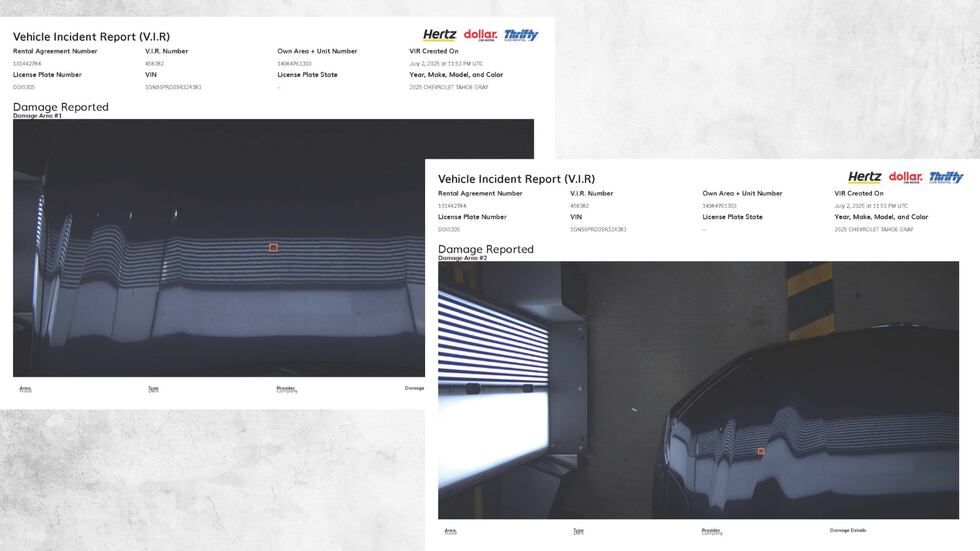
“I didn’t see any damage when I dropped off the car,” Fields said. “We weren’t involved in any accidents or mishaps on the road, so really just confused at what I was being charged $350 for.”
The bill included $160 for two dents and $190 in administrative fees. Initially, the charge was $350, but if she paid that day, it would be lowered to $290, she said.
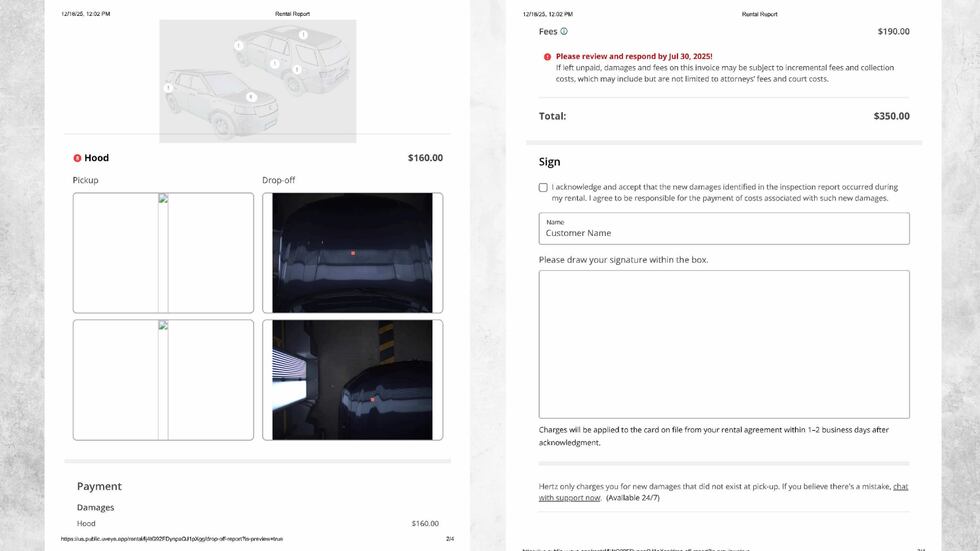
But Fields said she could not see any visible damage in the images. When she tried to dispute the charges, she said the link provided in the email did not work.
“They need to review their policy on how to dispute these AI damages because we know AI makes mistakes,” Fields said. “It wasn’t really clear that there were any avenues for dispute.”
Fields said she was not part of the drop-off inspection process and did not know the company was using AI machines.
For 10 months, Fields said she called, sat on hold, and emailed Hertz. She even filed a complaint with the Georgia Consumer Protection Division, the state’s consumer protection agency.
“It’s been very disappointing that I was not able to speak with anyone to dispute this,” Fields said.
In May, Hertz turned the unpaid damage bill over to a collection agency.
A clean checkout, then a $1,500 bill
Jessica Paciolla, a Pennsylvania small-business owner whose company sells generators, said she faced a similar situation after renting from Sixt, a luxury car rental company.
Paciolla and her husband traveled to Orlando for a meeting for their generator company. A trip to the Keys was on her bucket list, so they rented a car and drove from Orlando to Key West.
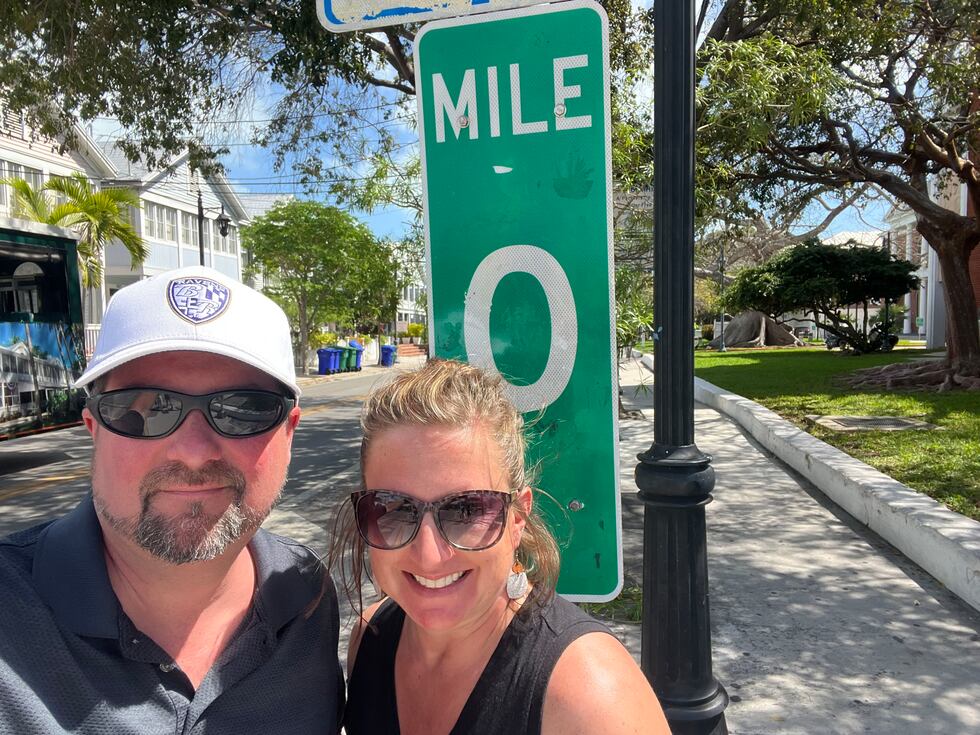
“We made a bunch of stops on the way,” Paciolla said. “We stopped in a couple of the Keys, and then we ended up in Key West.”
They rented the car in Orlando and picked it up from a hotel. Paciolla said she had never heard of Sixt before but found the company on Google because it was close to their hotel.
“We took an Uber to go get the rental,” Paciolla said. “Didn’t think anything of it. Rented the car, we looked at the car, looked fine to us.”
They drove to Marathon, stayed for a couple of days, and then drove to Key West. They later drove to Miami and flew out of Fort Lauderdale, where they dropped off the rental car.
When they returned the car, Paciolla said they drove through one of Sixt’s AI-powered arches, which the company calls car gates. Lights flashed on each side before they parked and talked to an employee who checked them out on an iPad.
“He said everything looked good,” Paciolla said. “There would be no additional charges. And off we went.”
Two days later, she received an email from Sixt saying the AI scanners had detected damage and that she needed to fill out a report.
“At that point, I was back in Pennsylvania, so I would have loved to have looked at the actual car,” Paciolla said.
Paciolla was sent photos from the AI scan, but she said she could not tell what damage the company was referring to. The images showed two orange boxes – one on either side of the vehicle.
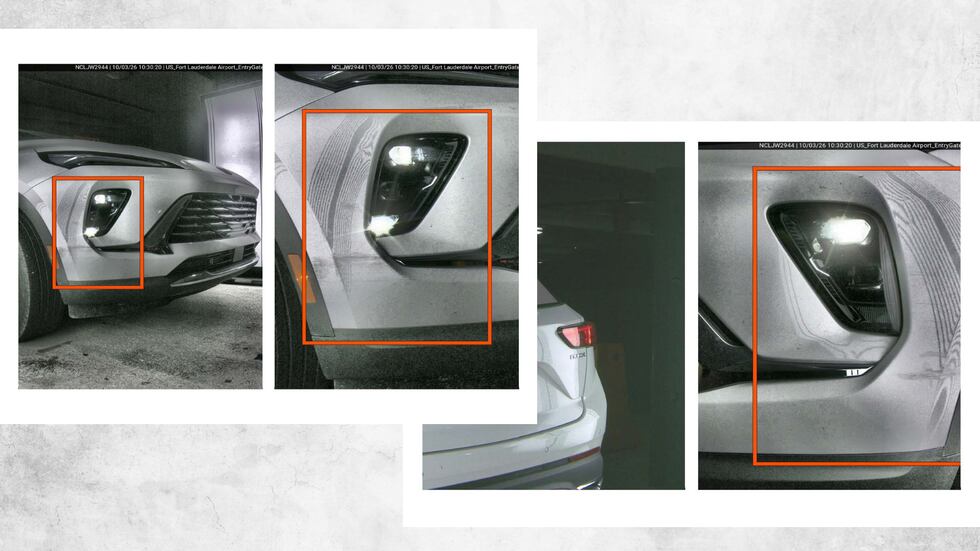
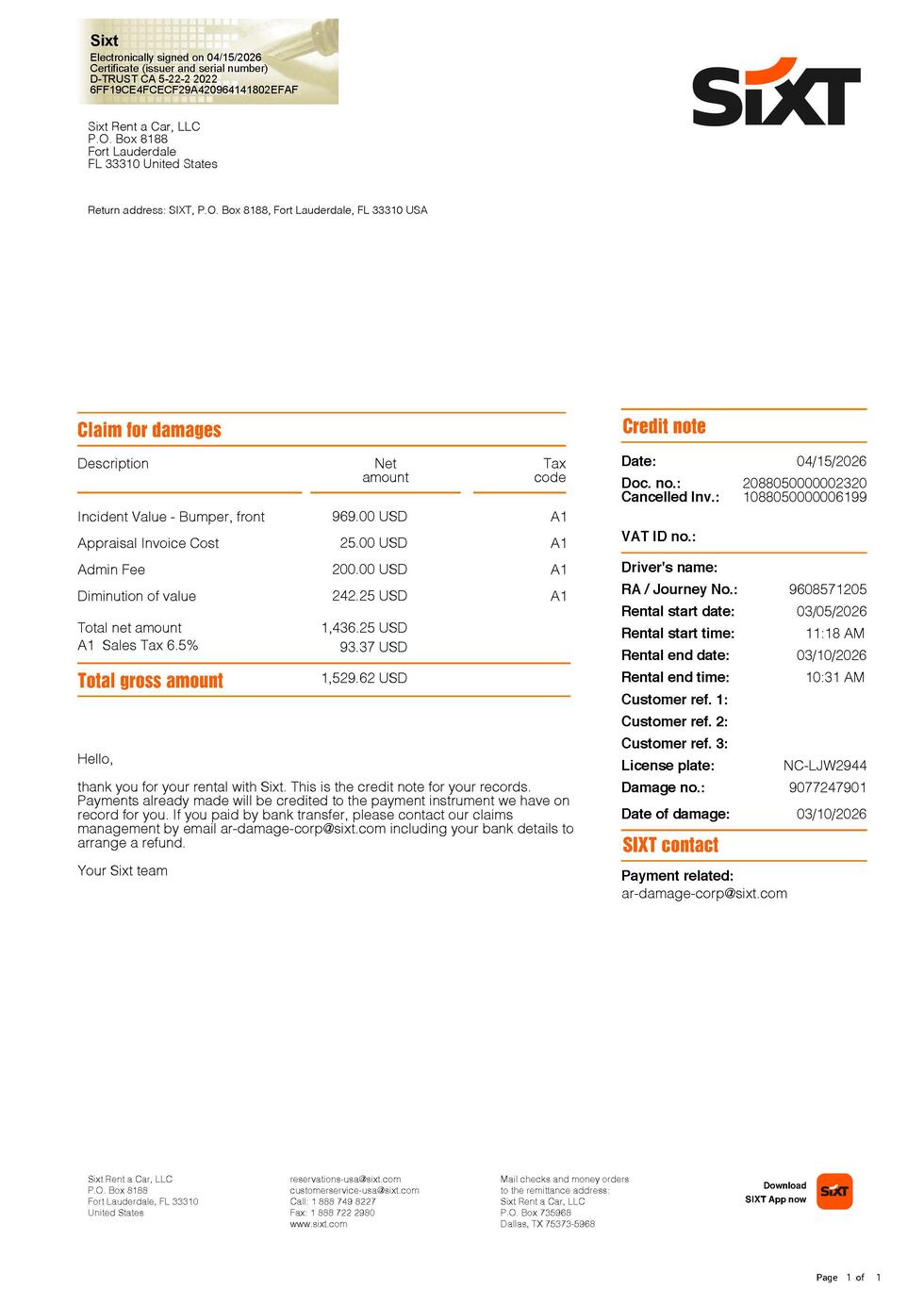
After filling out a report with three yes-or-no questions, she received a bill for $1,500 about a week and a half later.
“I was so mad I called my husband. I was like, ‘You’re never going to believe this,’” Paciolla said.
The charges were for two scratches greater than 10 centimeters. The bill included the car’s depreciation value, an appraiser fee and a $200 processing fee.
“You would think for $1,500, you would have think I would have noticed some kind of damage,” Paciolla said.
The car Paciolla rented was a Buick Envision, and the AI-analyzed photos showed large orange boxes around the corners of the front bumper. But Paciolla said the black-and-white images did not make clear what damage they were supposed to show.
When she looked at her rental history, it showed there was already damage to one front bumper, but the damage was listed as less than 10 centimeters. The damage Sixt later billed her for was listed as greater than 10 centimeters.
“If you’re going to charge me for something, you have to show me what it looked like when I left, right?” Paciolla said. “And there was no scanner at the hotel, only when I came back in.”
She asked the company for a comparison between the last scan before her rental and the scan taken when she returned the car. But she said she spent months trying to reach someone at Sixt and eventually received a call warning that her bill would be sent to collections.
“I would just like to talk to someone live and ask some questions,” Paciolla said. “If you’re going to send me a $1,500 bill, can I see a picture of the damage? An actual real life human picture?”
Questions about AI accuracy
Winters, the consumer advocate, said AI-detected images raise questions.
“We don’t know how accurate they are,” Winters said. “And when the company over defers to these companies and to the AI software about whether an actual thing was damaged or not, people might get charged for something they shouldn’t be.”
He said a human inspecting the car would likely never charge a customer for dirt or water droplets, but an AI system could flag those issues as damage and lead to a charge.
“The mistakes do happen,” Winters said. “And it’s really a difficult thing for consumers, frankly. There should be more responsibility on the rental car platforms to make sure that they are doing this accurately.”
Winters said rental car companies are not transparent about what systems they use, how those systems work and how they are integrated into the decision-making and billing process.
He said that’s another reason consumers need to document the car’s condition themselves.
“Just because as a consumer, if you see this fancy arch and all these millions of cameras and they’re talking about this AI technology, don’t sort of take your guard down and not take those pictures and not track it,” Winters said. “Continue to be vigilant about what you’re charged for, what happened and what the real case is, because AI does make mistakes.”
Experts say drivers should take detailed photos and videos of the rental vehicle when picking it up and dropping it off.
“Take video of the car and make sure if you go through an AI scanner, do not leave until you get the AI scanner report, because once you leave there’s nothing you can do,” Paciolla said.
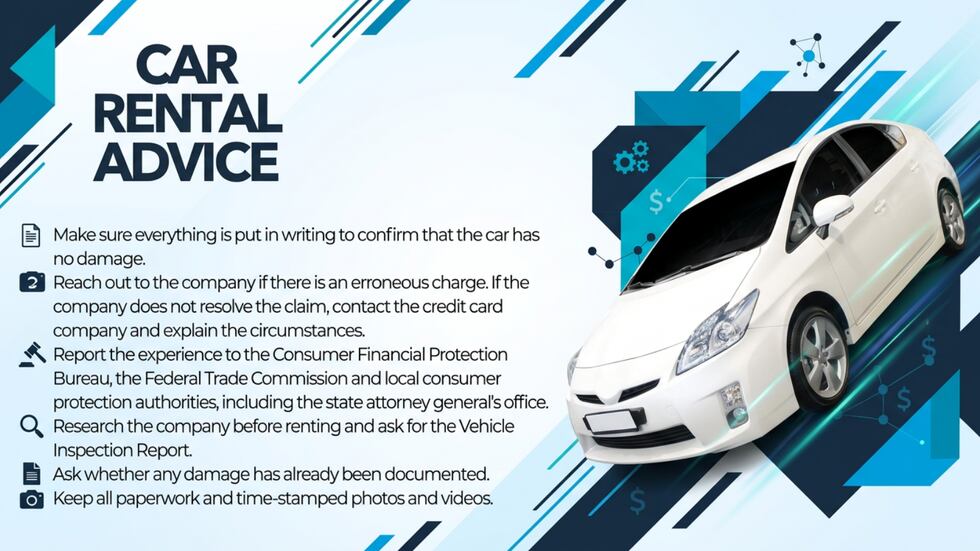
Consumers should also:
Cases resolved after inquiry
Paciolla’s bill is now gone. After InvestigateTV reached out to the company regarding the damage dispute, Sixt blamed a routing error and told her it was closing her claim as a “goodwill resolution.”
Sixt also told InvestigateTV in a statement:
“We are constantly working to enhance the rental experience by making vehicle handovers more efficient, transparent, and customer-friendly. One initiative is the use of innovative AI-supported “car gates” at select locations like airports. This technology, which is increasingly becoming an industry standard, automatically captures and documents the exterior condition of each vehicle as it enters and exits our parking areas, and these images are made available to customers. The result is greater transparency for both parties, a smoother pick-up and return process, and consistently high-quality vehicles – part of our commitment to providing a premium fleet. As advanced technology helps us, decisions are always made by human experts – if potential damage is detected, it always undergoes a human review to ensure a fair and accurate assessment."
“We appreciate your understanding that for competitive reasons we do not comment in depth on internal operational processes or specific technologies used within our network. However, we do provide detailed information about the use of car gates on our website: https://www.sixt.com/help-center/articles/car-gate/.”
Fields’ claim was also closed prior to InvestigateTV reaching out to Hertz about her bill.
A Hertz spokesperson said:
“Since implementation and when this rental occurred, we’ve continued to enhance our digital vehicle inspection experience based on customer feedback and operational insights. These enhancements include clearer customer communications, strengthened customer support, and more intuitive navigation on Hertz’s website support hub for customers with questions about a damage charge.
“Following a thorough review of the rental and ongoing communication with the customer, the claim associated with this reservation was closed in full last month and the customer has no financial responsibility.”
Both women now have resolutions: their cases are closed, and neither owes money. But they warn drivers to keep an eye out the next time they rent a car.
Copyright 2026 Gray Media Group, Inc. All Rights Reserved.